Customizable Curved Tube hair dryer: Engineering, Performance, and Market Trends
Industry Background and Market Demand
The hair care appliance industry has evolved significantly, driven by consumer demand for ergonomic, efficient, and customizable tools. Traditional hair dryers often feature rigid designs, limiting adaptability for professional stylists and home users. The customizable curved tube hair dryer addresses this gap by offering adjustable airflow direction, enhanced ergonomics, and improved heat distribution.
Market research indicates a growing preference for modular and user-configurable beauty tools, particularly in salons and high-end retail. Professionals seek devices that reduce wrist strain, while consumers prioritize precision styling. This trend has led manufacturers to explore advanced materials, variable airflow systems, and modular attachments.
Core Concept and Key Technologies
A curved tube hair dryer integrates a flexible or adjustable nozzle, allowing users to modify the airflow angle without repositioning the device. Key technologies enabling this functionality include:
- Variable Airflow Geometry: Adjustable ducts or swivel joints redirect airflow while maintaining consistent pressure.
- Thermal Management: Advanced heating elements prevent localized overheating, ensuring uniform temperature distribution.
- Ergonomic Weight Distribution: Lightweight composites balance the device, reducing fatigue during prolonged use.
Unlike fixed-tube dryers, customizable models use reinforced polymers or lightweight alloys to maintain structural integrity under repeated adjustments.
Product Structure, Materials, and Manufacturing
Structural Design
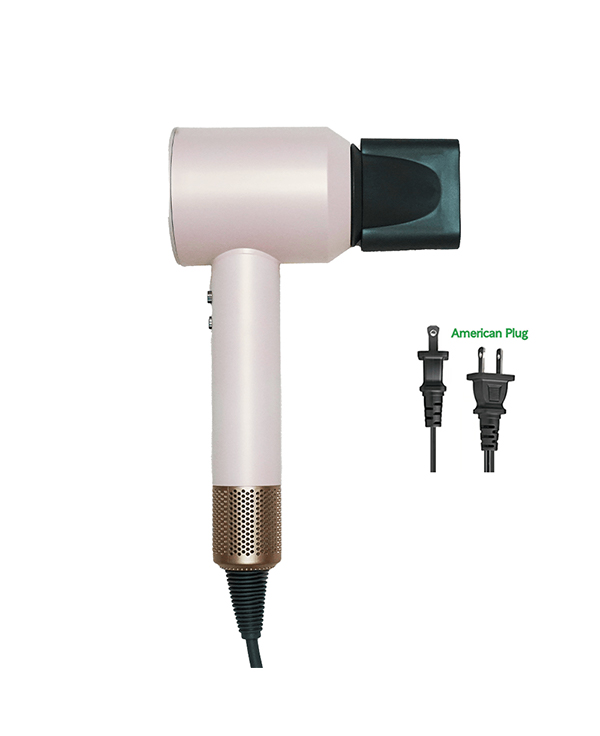
The dryer consists of:
- Base Unit: Houses the motor, heating coil, and control circuitry.
- Adjustable Tube: A reinforced polymer or aluminum joint enables 30°–90° rotation.
- Nozzle Attachments: Interchangeable concentrators or diffusers enhance styling versatility.
Material Selection
- High-Temperature Plastics: Polyetherimide (PEI) or polyamide resins withstand prolonged heat exposure.
- Metal Alloys: Aluminum or magnesium reduce weight while ensuring durability.
- Silicone Gaskets: Seal joints to prevent air leakage.
Manufacturing Process
Precision injection molding forms the housing, while CNC machining ensures tight tolerances for moving parts. Automated quality checks verify thermal stability and airflow consistency.
Critical Factors Affecting Performance
1. Airflow Efficiency: Turbulence in curved sections can reduce output; computational fluid dynamics (CFD) optimizes duct geometry.
2. Heat Dispersion: Uneven heating risks damage to hair; ceramic or tourmaline coatings mitigate hotspots.
3. Durability: Hinge mechanisms must endure 10,000+ cycles without failure.
4. Power Consistency: Brushless motors maintain RPM under variable loads.
Supplier and Supply Chain Considerations
Reliable suppliers must meet:
- Material Certifications: UL, RoHS, or REACH compliance for plastics and electronics.
- Precision Machining Capabilities: Sub-millimeter tolerances for moving parts.
- Thermal Testing: Third-party validation of heat resistance and electrical safety.
OEMs often partner with specialized injection molding firms and motor manufacturers to ensure component interoperability.
Common Challenges and Industry Pain Points
- Joint Wear: Frequent adjustments may loosen hinges over time; self-lubricating polymers mitigate this.
- Air Leakage: Poorly sealed ducts reduce efficiency; ultrasonic welding improves seam integrity.
- Cost vs. Performance: Balancing lightweight materials with durability increases production costs.
Applications and Use Cases
- Salons: Stylists benefit from adjustable angles when working around clients’ heads.
- Home Users: Curved designs simplify self-styling, particularly for layered cuts.
- Travel: Compact, foldable models integrate curved nozzles for portability.
Current Trends and Future Developments
1. Smart Integration: IoT-enabled dryers with humidity sensors and adaptive heat settings.
2. Sustainable Materials: Biodegradable polymers and recycled metals gain traction.
3. Enhanced Modularity: Magnetic nozzle attachments for tool-free customization.
FAQ
Q: How does a curved tube improve drying efficiency?
A: By redirecting airflow without repositioning the dryer, it reduces heat loss and speeds up styling.
Q: Are curved tubes compatible with ionic technology?
A: Yes, many models integrate negative ion generators to reduce frizz.
Q: What maintenance ensures longevity?
A: Regular cleaning of air filters and avoiding forced adjustments beyond the designed range.
Conclusion
The Customizable Curved Tube Hair Dryer represents a convergence of ergonomic design and advanced engineering. As demand grows for adaptable, high-performance tools, manufacturers must prioritize material innovation, precision manufacturing, and user-centric design. Future advancements will likely focus on sustainability and smart functionality, further solidifying this product’s role in professional and consumer markets.
 Dongguan Allgreen Intelligent Technology Co., Ltd.





 Phone
Phone
Comment
(0)