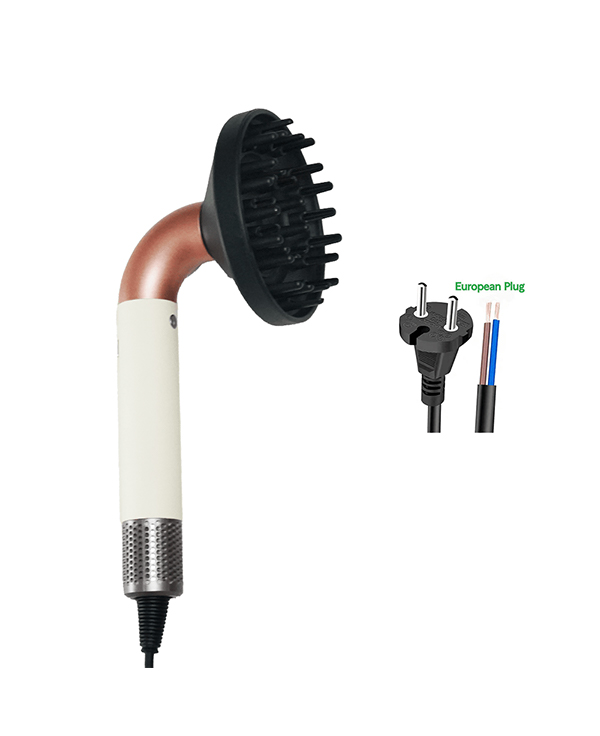
Lightweight Powerful hair dryer: Strong Performance Without the Bulk
Industry Background and Market Demand
The professional haircare industry has seen a growing demand for lightweight yet Powerful Hair Dryers that deliver high-speed drying without compromising ergonomics. Salon professionals, in particular, require tools that minimize fatigue during extended use while maintaining thermal precision and airflow efficiency.
Traditional hair dryers often sacrifice power for reduced weight or vice versa, creating a gap in the market for devices that balance both. Consumer preferences have also shifted toward compact, travel-friendly models without sacrificing performance. This trend has driven manufacturers to innovate in motor efficiency, material selection, and heat management.
Core Technology: High-Efficiency Motors and Aerodynamics
The key to achieving strong performance in a Lightweight hair dryer lies in two critical components: the motor and the airflow design.
1. Brushless DC Motors – Unlike conventional AC motors, brushless DC motors are smaller, lighter, and more energy-efficient. They generate less heat, extend product lifespan, and allow for variable speed control without excessive bulk.
2. Optimized Airflow Channels – Advanced computational fluid dynamics (CFD) modeling helps refine internal ducting to maximize airflow while minimizing turbulence. This ensures faster drying times with lower noise levels.
Product Structure, Materials, and Manufacturing
A high-performance lightweight hair dryer typically consists of:
- Housing: Reinforced polymers (e.g., polycarbonate blends) provide durability without adding weight. Some premium models use magnesium alloy for heat resistance and structural integrity.
- Heating Element: Ceramic or tourmaline-coated heating elements distribute heat evenly, reducing hot spots and hair damage.
- Nozzle Design: Concentrator attachments are engineered to focus airflow precisely, improving drying efficiency.
Manufacturing processes include precision injection molding for housing components and automated quality checks to ensure motor alignment and thermal regulation.
Key Factors Affecting Performance and Quality
1. Motor Efficiency – A high-rpm motor must maintain consistent power output without overheating.
2. Thermal Management – Overheating can degrade components; effective heat dissipation is critical.
3. Ergonomics – Weight distribution and grip design impact user comfort during prolonged use.
4. Durability – Materials must withstand daily professional use, including accidental drops.
Supplier and Supply Chain Considerations
Reliable suppliers for critical components include:
- Motor Manufacturers: Specialists in brushless DC motors with certifications for energy efficiency.
- Material Providers: High-grade thermoplastics or metal alloy suppliers with ISO compliance.
- Electronics Suppliers: PCB and thermal sensor producers with RoHS and REACH compliance.
Supply chain resilience depends on component traceability and redundancy in sourcing to prevent disruptions.
Common Industry Challenges
1. Balancing Power and Weight – Some manufacturers struggle to reduce bulk without compromising airflow velocity.
2. Heat Damage Risks – Poor thermal regulation can shorten product lifespan or cause safety issues.
3. Consumer Misconceptions – Some users equate higher wattage with better performance, overlooking motor efficiency.
Applications and Use Cases
- Salon Professionals: Require lightweight dryers for all-day use without hand strain.
- Travel-Friendly Models: Compact designs with dual-voltage compatibility for global use.
- Luxury Home Use: Consumers seeking salon-grade performance in a lightweight form factor.
Current Trends and Future Developments
1. Smart Features – IoT-enabled dryers with humidity sensors and adaptive heat control.
2. Sustainable Materials – Increased use of recycled plastics and biodegradable components.
3. Enhanced Battery Tech – Cordless models with fast-charging capabilities for greater mobility.
FAQ
Q: How does a lightweight hair dryer achieve high airflow without a bulky motor?
A: Brushless DC motors and optimized aerodynamics allow compact designs to deliver strong airflow efficiently.
Q: Are lightweight dryers durable enough for salon use?
A: Yes, when constructed with reinforced polymers or magnesium alloy, they withstand daily professional demands.
Q: What is the trade-off between wattage and drying speed?
A: Wattage alone doesn’t determine performance; motor efficiency and airflow design are equally critical.
Conclusion
The evolution of lightweight powerful hair dryers reflects advancements in motor technology, materials science, and ergonomic design. As demand grows for high-performance yet portable solutions, manufacturers must continue refining efficiency, durability, and user experience. Future innovations will likely focus on sustainability and smart functionality, further transforming the industry.
 Dongguan Allgreen Intelligent Technology Co., Ltd.





 Phone
Phone
Comment
(0)