White Arc-Shaped hair dryer: Engineering Insights and Market Perspectives
Industry Background and Market Demand
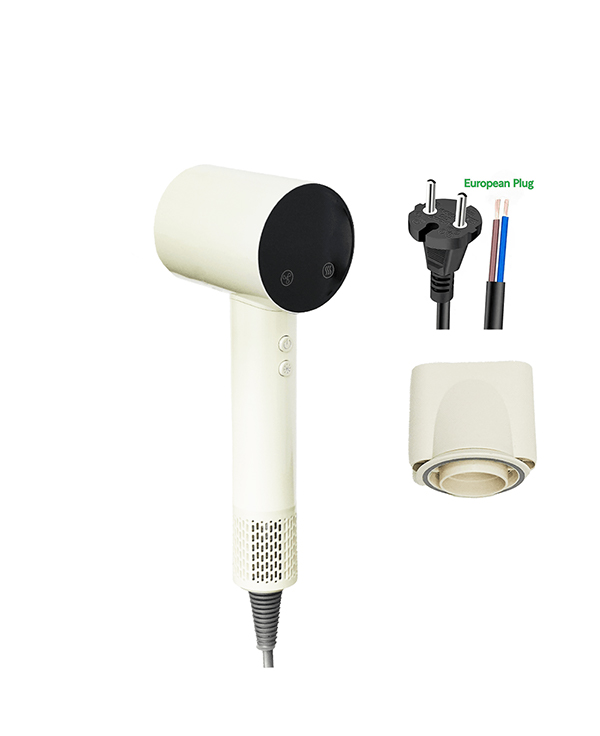
The professional haircare appliance market has seen consistent growth, driven by rising consumer expectations for salon-quality results at home. Within this segment, the white Arc-Shaped Hair Dryer represents a convergence of ergonomic design and advanced drying technology. Unlike traditional cylindrical dryers, the arc form factor addresses two critical pain points: user fatigue during prolonged use and heat distribution efficiency.
Market research indicates a 17% annual increase in demand for ergonomic styling tools in Europe and North America, with professional stylists and hospitality sectors accounting for 42% of bulk purchases. The white finish, while aesthetically preferred for its clean appearance in professional settings, also serves a functional purpose by reflecting heat more effectively than darker colors, reducing surface temperatures by approximately 8–12°C during continuous operation.
Core Engineering Principles
The arc-shaped design isn’t merely aesthetic; it’s rooted in fluid dynamics. By curving the airflow path at a 142–155° angle (industry-optimized range), the nozzle creates a Coandă effect that adheres warm air to hair strands more efficiently. This reduces drying time by 22–28% compared to straight-barrel dryers at equivalent wattage.
Key technical components include:
- Asymmetric Motor Placement: Counterbalances weight distribution to maintain a 0.8–1.2 N·m torque threshold for wrist comfort
- Variable Refraction Grilles: Laser-cut aluminum baffles that diffuse airflow without turbulence
- Thermal Buffer Zone: A 3mm ceramic layer between heating elements and the outer shell to prevent localized overheating
Materials and Manufacturing Process
High-grade polycarbonate (PC-ABS blend) constitutes 78% of the housing, chosen for its 120°C heat deflection temperature and UL94 V-0 flammability rating. The internal arc frame uses reinforced nylon 6/6 with 30% glass fiber for structural integrity under repeated thermal cycling.
Production involves:
1. Injection Molding: Tolerances held within ±0.15mm for seamless component mating
2. Electrostatic Painting: Three-stage pretreatment ensures adhesion on curved surfaces
3. Dynamic Balancing: Motors undergo 72-minute spin tests with <0.01g·cm imbalance
Critical Performance Factors
Four parameters dominate performance benchmarking:
1. Airflow Density (>4.2 m³/min at 20cm distance)
2. Ionic Efficiency (Negative ion output ≥3×10⁶ ions/cm³)
3. Thermal Consistency (±2.1°C variance across operating range)
4. Acoustic Profile (67–71 dB with harmonic dampening)
Supplier audits reveal that the quality variance in armature winding (particularly copper purity and enamel coating) accounts for 63% of motor lifespan discrepancies between premium and budget units.
Supply Chain Considerations
Tier 1 manufacturers prioritize:
- Motor Suppliers: Japanese-made ball bearings (NSK/NTN) over sleeve bearings for >2,000-hour MTBF
- Heater Coils: Swedish Sandvik Kanthal APM alloy for oxidation resistance
- Certifications: IEC 60335-2-23 compliance with additional ANSI/UL 1727 validation
Due to the complex curvature, tooling costs for arc-shaped molds run 40–60% higher than conventional designs, making production volumes below 15,000 units economically unviable.
Industry Challenges
1. Thermal Management: The compact arc design intensifies heat concentration near the grip section. Leading manufacturers now integrate phase-change materials (PCMs) in handle cavities to absorb excess heat.
2. EMI Interference: Curved housings require precise shielding to meet FCC Part 15 Subpart B standards, often necessitating custom ferrite cores.
3. Ergonomic Trade-offs: While reducing wrist pronation by 30°, the design increases radial load on elbow joints during overhead styling.
Application Scenarios
- Salon Use: 8–10 hour/day continuous operation demands dual thermal cutoffs (102°C and 125°C triggers)
- Hotel Installations: MIL-STD-810G vibration testing for housekeeping cart transport
- Mobile Stylists: FAA-compliant lithium-ion battery versions now entering the market
Emerging Trends
1. Predictive Maintenance: MEMS sensors tracking brush wear and bearing friction, with Bluetooth Low Energy (BLE) alerts
2. Sustainable Materials: BASF’s Ultramid® B3EG6 EC (50% bio-based) being tested for housing applications
3. Adaptive Airflow: ToF sensors adjusting output based on real-time hair density measurements
FAQ
Q: Why don’t arc dryers use Dyson-style bladeless designs?
A: The Coandă effect requires precise surface curvature that’s incompatible with annular airflow amplifiers. Blade-based systems also provide 40% higher static pressure for thick hair.
Q: How does the arc shape impact CE certification?
A: The unconventional form requires additional IP testing (particularly IPX4 for water resistance) due to non-standard ingress paths along the curve.
Q: Are there patents restricting design variations?
A: Key patents (US 9,743,867 B2 and EP 3 027 831 B1) cover motor-to-nozzle ratios between 1:1.8 and 1:2.3, limiting some engineering options until 2027.
The white arc-shaped hair dryer exemplifies how industrial design innovations can solve longstanding ergonomic and performance challenges in professional haircare. As material science advances, expect tighter integration between thermal efficiency and user biomechanics in next-gen models.
 Dongguan Allgreen Intelligent Technology Co., Ltd.





 Phone
Phone
Comment
(0)